
Zero tolerance and a growing backlog, on the same stations
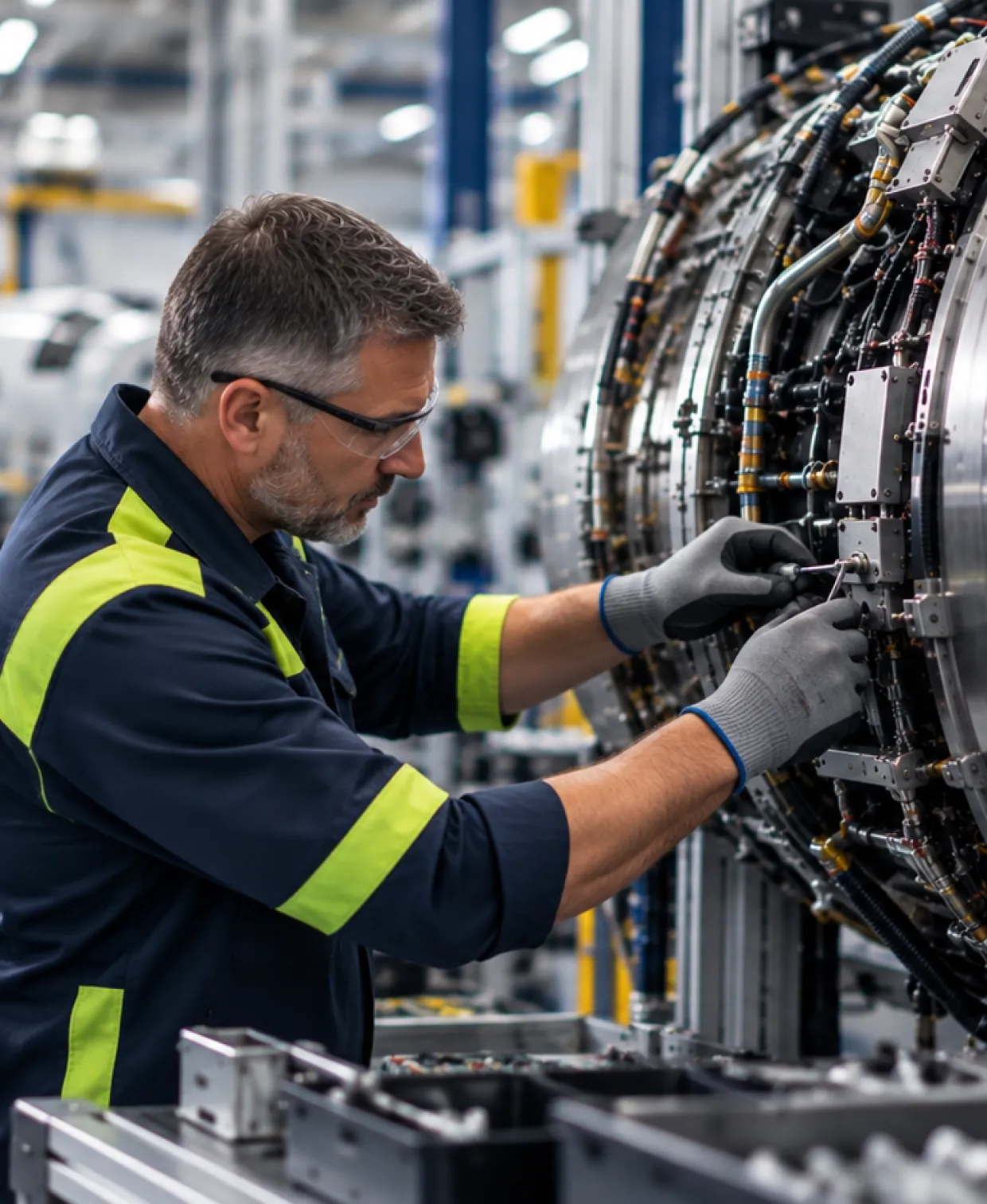
A turboprop engine, a cockpit system, a landing gear assembly. Builds like these run eighty to a hundred hours across twenty stations, and until the test bench no one knows whether every step happened the way the work instructions define it. One camera above each manual station checks that on every cycle. The operator is alerted while the piece is still at the station, and a deviation that used to surface at final test surfaces in seconds.
Live in two weeks. No MES integration required. Your work instructions are the only input Operator Vision needs.
You’re asked to move faster without moving the quality bar
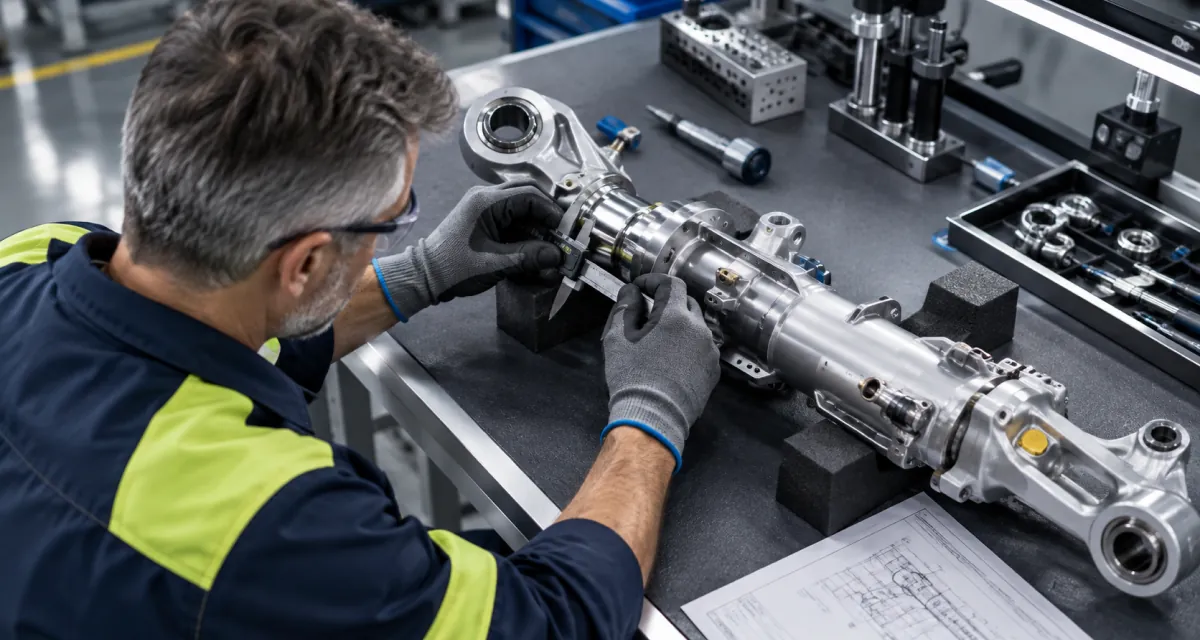
Rigorous inspection, re-inspection, and test are the backbone of this industry and none of that is negotiable. At the same time the backlog grows, and executives and customers ask about throughput every week. The usual levers don’t help. You can’t automate work that runs in the tens or hundreds per year. Add inspection and you add hours to a build that’s already long. Take inspection steps out to win those hours back and you raise the odds of a missed step reaching an assembly worth tens of thousands of dollars. Meanwhile the record of the build is thinner than it looks. Most plants report at the station level, but operators log several steps at once to avoid losing time to the system, so the timestamps describe when the record was written rather than when the work happened. Reporting then refreshes daily. On a build crossing twenty stations over several days, that gap is where the backlog actually lives.
The deviations that reach the test bench
A step performed out of order, or not at all
On a long build with many stations, the step that gets missed is the one that looks redundant until a test fails and no one can say which station it came from.
Errors that only appear at test
Rework on a completed assembly means teardown, repair, and retest. The failure costs hours. Finding out which step caused it costs more.
A record written after the fact
Operators log several steps at once when the work is finished rather than one at a time, because stopping to log each step costs build time. The record ends up describing what was remembered rather than what was observed, and a certified inspector still has to review it.
Handling and staging on high-value parts
A part that touches a surface it shouldn’t, a component staged where the next operator won’t look, a scratch on a finish that isn’t tolerated. On a part worth tens of thousands, each of those is a scrap decision.
Step-level flow
You know which station a unit is at. What no system shows you is how long each step inside that station actually took, which is the level where a bottleneck can be found and fixed.

What the work is costing before anyone measures it
- 50–70%
- of scrap at high-mix, low-volume manufacturers traces back to how the work was performed, rather than to suppliers or design
- 15–30%
- of throughput lost when operators drift from the standard
- Half
- the time your continuous improvement engineers spend on manual time studies, given back. That’s the target Assembler AI builds to.
One camera feed. All four modules
You don’t buy these separately. One camera feed above the station runs all four at once, with no MES integration required
Real-Time Quality Alerts
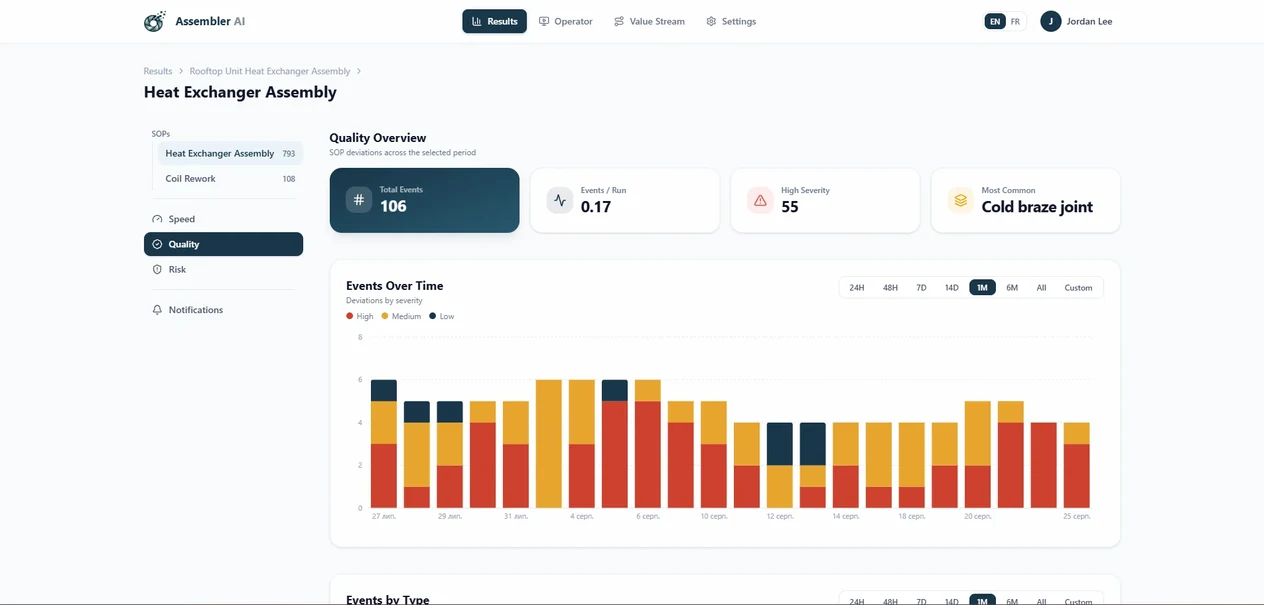
Every step in the work instructions confirmed or flagged, in sequence, on every cycle. A missed step is caught in seconds instead of surfacing at end-of-line inspection or on the test bench, and every step carries timestamped video behind it
Explore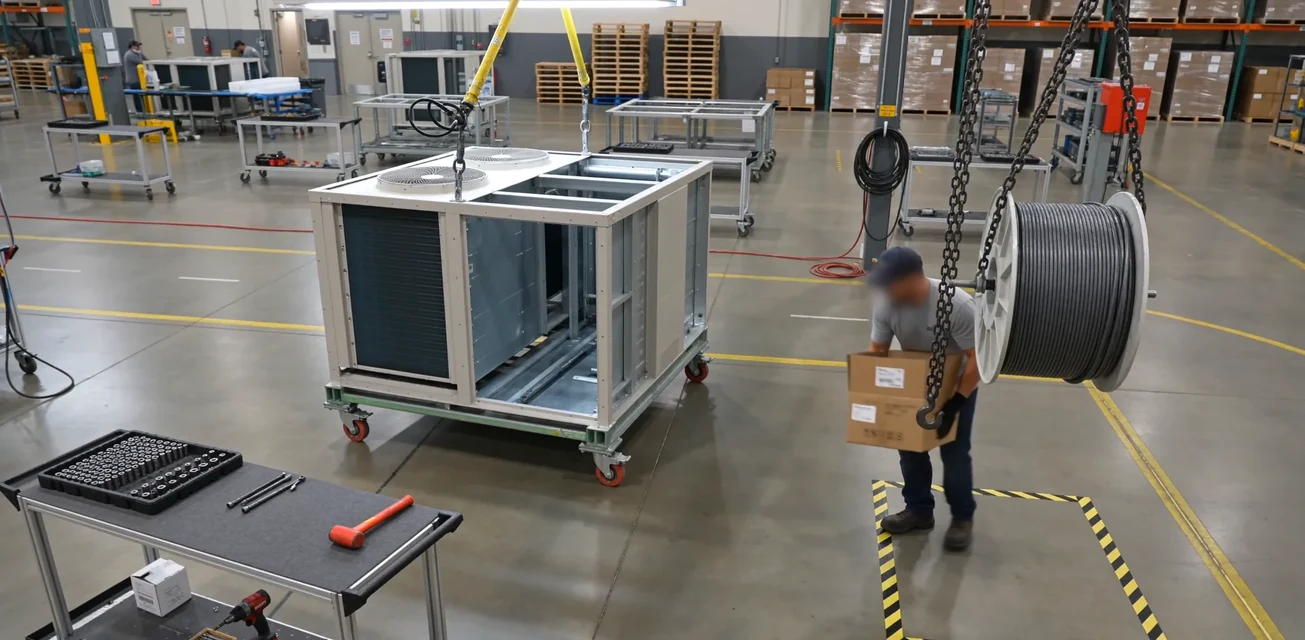
Continuous Improvement Insights
Actual cycle times for every step, measured against the takt you planned to. You see where a station runs over, which step drifts, and on which shift, with video on every outlier.
Explore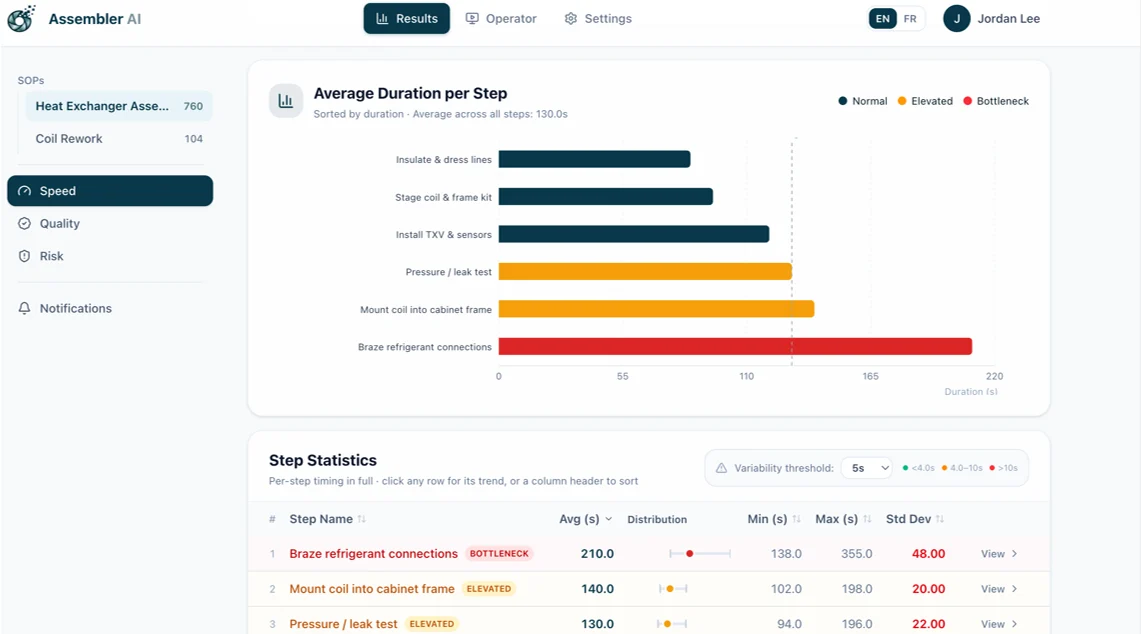
Real-Time Operator Guidance
A screen at the station that alerts the operator the moment a step is skipped or performed out of sequence, so the build gets corrected while the piece is still there rather than at the inspection station
Explore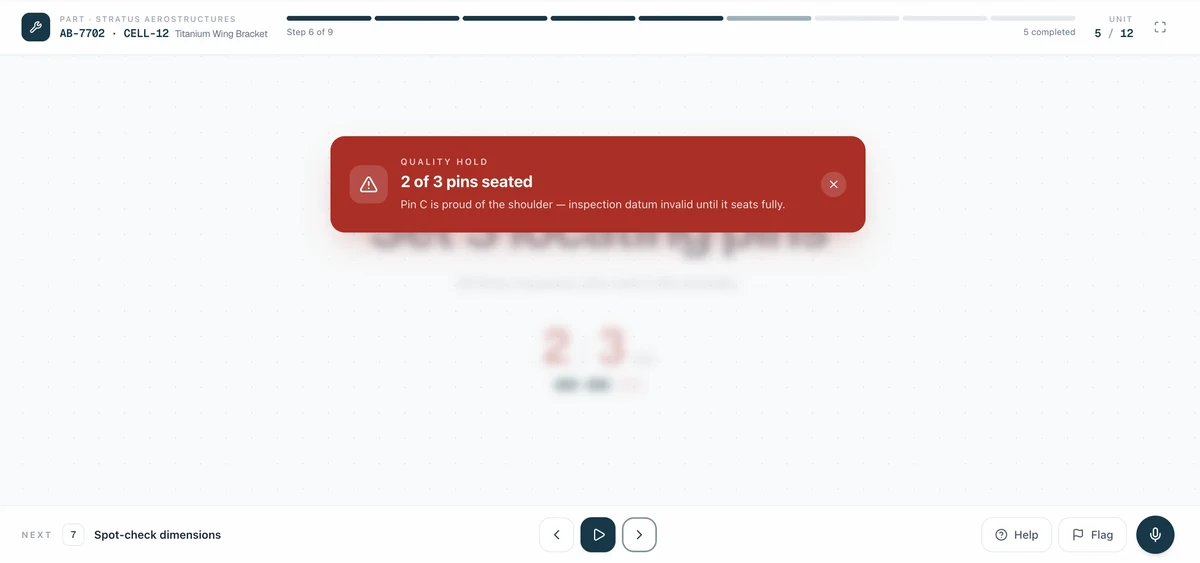
Real-Time Risk Detection
The list your work instructions never cover. Handling rules on high-value parts, staging discipline, and keep-clear zones around finished surfaces
ExploreWho this is for, and what they get
Quality
Every step verified against the work instructions on every unit, not on the ones somebody sampled. When a test failure sends you looking for a cause, the video of the actual cycle is one click from the alert, so root cause analysis becomes a lookup instead of an investigation.
Continuous improvement
A time study that runs itself across every station in a multi-day build, instead of the quarterly pass with a stopwatch. Step-level variance by station and shift, with video on every outlier, and improvement tracking that shows what each change actually did.
Operations leadership
Live flow across all the stations in a build rather than a report that refreshes overnight. You see where a unit actually is, which station is holding the line, and what that costs in days of backlog.
Operators and production managers
New operators reach the rate of your experienced ones sooner, because the correction arrives at the station while it still costs seconds. Faces are blurred, no names or IDs are collected, and the footage protects the operator who did the job right as often as it flags the one who didn’t.
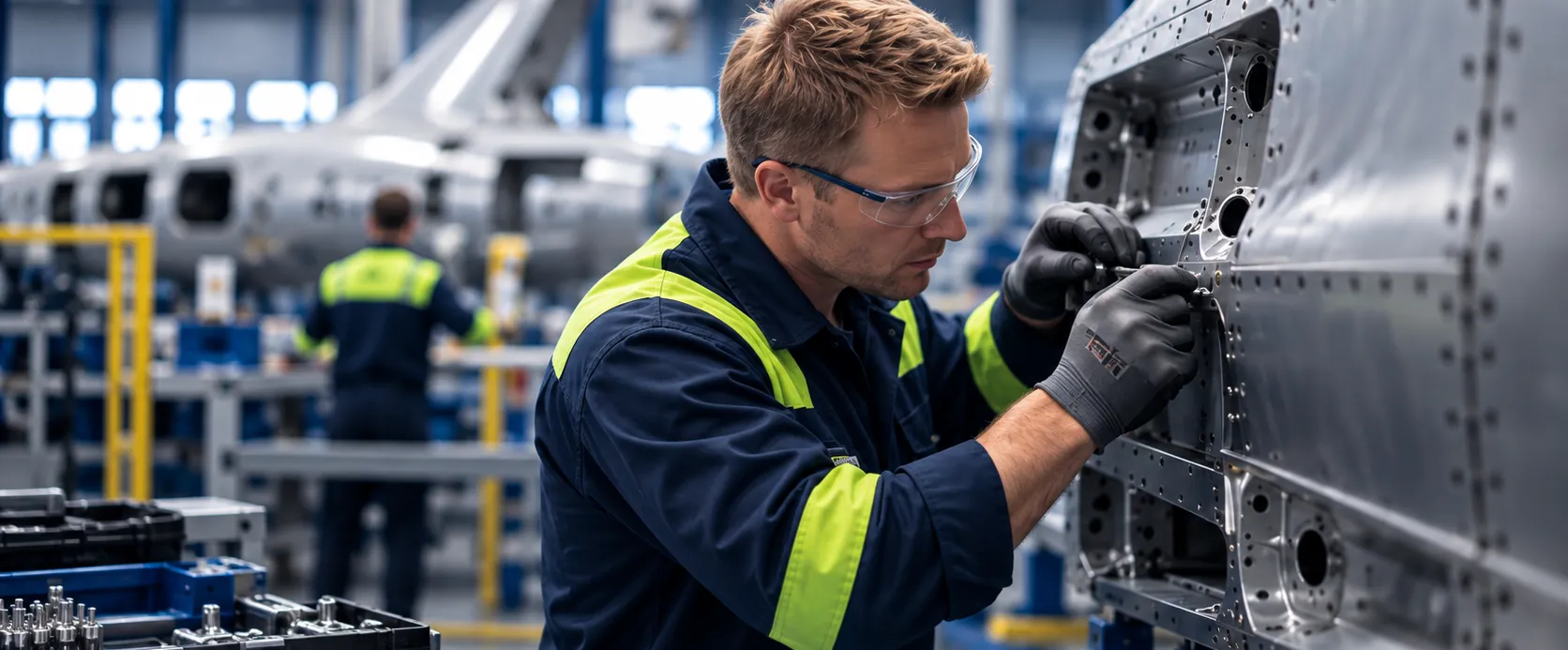
Where this runs in an aerospace manufacturing plant
01Assembly and subassembly
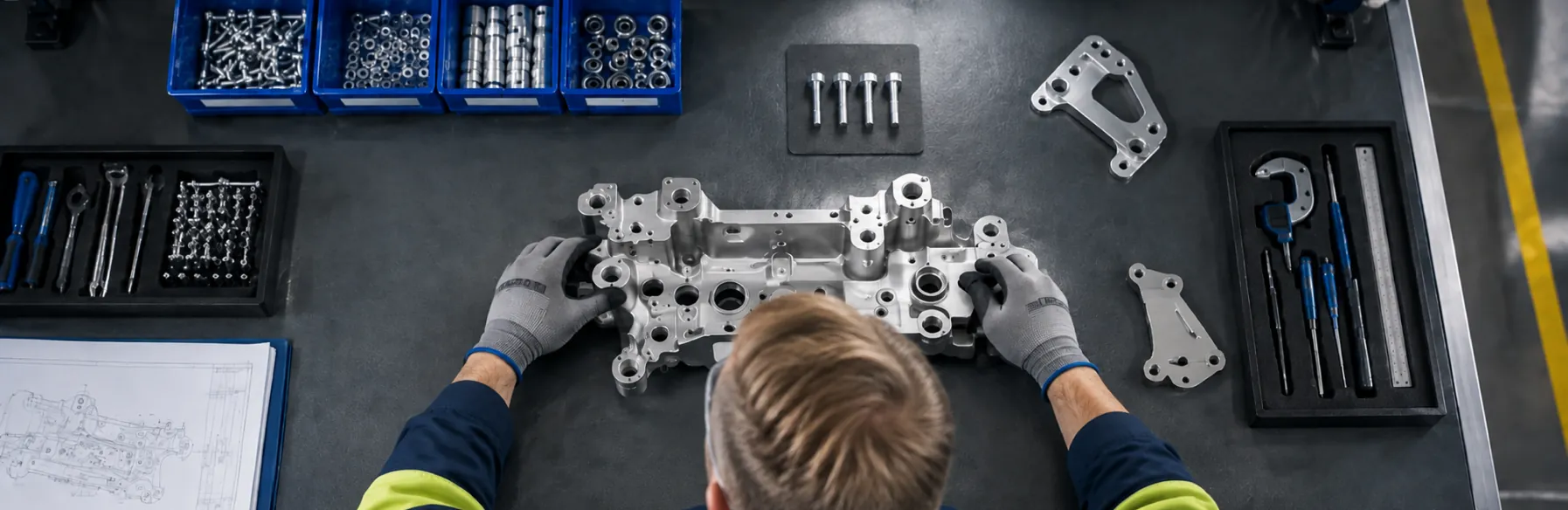
Wrong sequence, missing components, wrong part, wrong number of fasteners
See assembly02Inspection benches
Dwell time, both sides of the part, scrap and pass counts without a clipboard
See inspection03CNC and machining cells
Setup, tool change, orientation, measurement, deburr, final check
See CNC04Kitting and packaging
The right components in the right kit, and the right count in the right container
See assembly
If you supply military as well as commercial customers, the security review comes before the technical one, and we would rather have it early.
- US or Canadian data residency, your choice
You pick the region at deployment. Production data lives there and stays there, encrypted in transit and at rest under a customer-managed key issued to you.
- A network footprint your IT team can approve
The camera sits on its own subnet and streams out over an encrypted VPN, so the only thing that opens is one outbound path. Nothing connects to your production network.
- Documentation written for reviewers
Our security overview goes to IT and legal rather than to marketing.
- NDAA-compliant hardware
Off-the-shelf cameras Assembler AI supplies and provisions, with no restricted foreign-made surveillance equipment anywhere in the stack.
If your programs carry specific certification or handling requirements, tell Assembler AI in the first conversation and we’ll be straight with you about where we stand against them.
Two weeks, and the build doesn’t stop
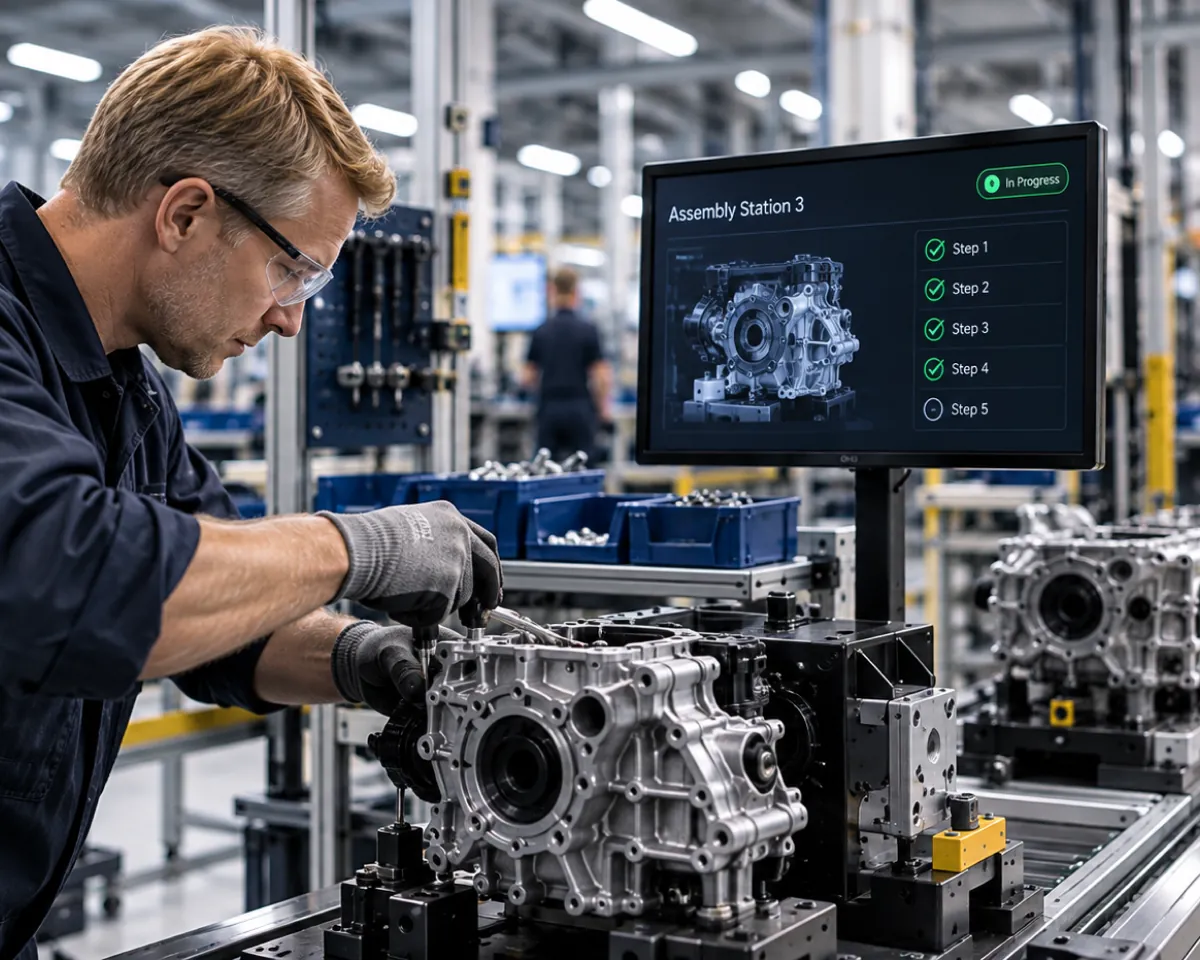
Send the work instructions you already have on day one, and if a station has none written down, Assembler AI will work with you to create them. The camera goes up in week one, NDAA-compliant hardware Assembler AI supplies and provisions, on its own subnet, streaming out over an encrypted VPN. Nothing about the station changes. Week two is calibration and training the model on your alerts. Anything the camera sees that your paperwork doesn’t account for gets resolved with your team before a rule goes live on day fifteen. That’s two weeks on a station with one operator, closer to three where several people share a station. Stations after the first go up in parallel, so covering a full build line is measured in weeks rather than one station at a time.
See what deployment looks likeStart with one station. The data gets more valuable with every one you add
No one instruments a plant on a vendor’s promise. So you start small, with the station producing the most rework or the most unexplained variance. Two weeks later you have step-level data on your own parts.
What happens after is worth understanding before you begin. This data is comparative, so every station you add makes the ones you already have more useful.
One station
What happens after is worth understanding before you begin. This data is comparative, so every station you add makes the ones you already have more useful.
The build line
Twenty stations instrumented is the first time step-level flow across a multi-day build becomes visible while it’s still happening. The bottleneck station becomes the one you can work on next, and every hour recovered there comes straight off the backlog.
The factory
Shifts and cells compare against each other. When you change a process, you can see what it did to throughput on the next run rather than waiting for the next study.
Across sites
The same assembly built in two plants becomes comparable for the first time, with video from both. The best method in your group becomes the standard across it.
If you’re heading toward multiple sites, tell Assembler AI early and we’ll scope single sign-on, role-based permissions, and per-site data separation with your IT and HR teams while the first station runs.
Questions your team will ask
That’s the environment where this pays back fastest. Each station is instrumented independently and the data joins up across the build, so you get step-level detail at each station and flow across all of them.
Only if it’s logged as it happens. Where operators batch several steps together to keep moving, the record reflects when it was written rather than when the work was done. Operator Vision logs each step as it occurs with timestamped video behind it, which is a stronger record and costs the operator nothing.
No, and be careful with any vendor who says otherwise. What it does is make sure the steps before the inspection happened as written, so the inspection finds fewer surprises and the ones it finds have video attached.
Operator Vision needs to observe enough production cycles to learn a station, and low volume means those accumulate over a longer window. Tell Assembler AI your build rate and we’ll be straight with you about the timeline for that station.
One camera covers one station. Where an operator works both sides of a large assembly, that station gets a two-camera setup, sized at the walkthrough rather than discovered in week three.
No. Your work instructions are the only required input. Assembler AI provides MES and ERP integrations when you want data flowing both ways.
Assembler AI’s proprietary manufacturing vision models start around 80 percent accuracy on a new station and get to the mid 90s after the initial calibration. Those first two weeks are what get it there on your parts rather than in a demo.
You do. Encrypted in transit and at rest, isolated per customer, default twelve-month retention you can change or export from at any time.
Start with the errors that only show up at final test
Choose the station where a mistake stays hidden the longest. Operator Vision goes live there in two weeks, and you’ll see how often it’s happening on your own parts, with video.
No MES integration required, and it scales easily across your sites.