
Your customer shouldn’t be the one who finds the missing fastener
Your customer calls about a missing fastener on a bracket you shipped three weeks ago. Your team spends the afternoon reconstructing that build from travelers, memory, and guesswork. The station kept no record, so there was never an answer to give. One camera above the bench checks every step and every count against your work instructions. When something goes wrong the operator is notified while the piece is still at the station, and the correction costs seconds instead of a sorting crew.
Live in two weeks. No MES integration required. Runs on the same camera feed as the rest of Operator Vision.
Two numbers that never move in the same direction
Your customer expects zero defects and a price that drops every year. Those demands land on the same stations, and the usual answer to one makes the other worse. Automate and you need volume that high-mix work never gives you. Add an inspector and you’ve added cost to a line already under a price-down clause. Run leaner and the escapes go up. The work an operator does sits in the middle of that squeeze with less data on it than any machine in your plant. Your presses and your CNC machines report. The loading, checking, deburring, and boxing that happens around them does not, and that’s where the escapes come from.
The defects that make it out the door
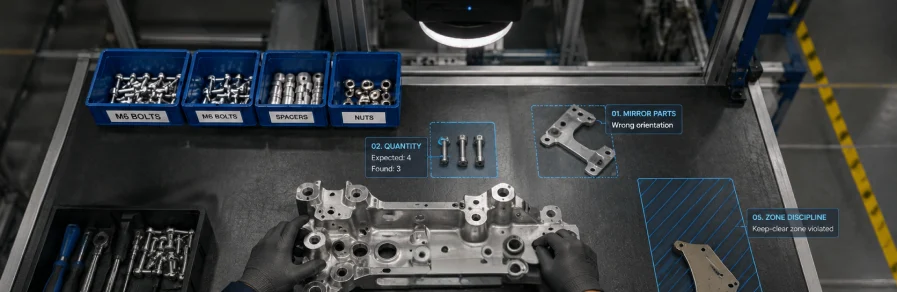
01. Mirror parts
Left and right
Mirror-image parts are the signature automotive escape. A left-hand fender in a right-hand box, a door molding in the wrong carton, a kit built with two of the same side. The parts look correct because they are correct. They’re just in the wrong place.
02. Quantity
Counts
A pallet ships with thirteen instead of fourteen. Nobody counted, because counting is what the operator does while doing four other things.
03. Sequence
Skipped steps
On bracket and subassembly stations, the step that gets dropped is the one that looks optional right up until it isn’t.
04. Dwell time
Rushed inspection
When parts stack up at the bench, the inspection that should take three seconds takes one. The operator isn’t cutting corners so much as absorbing an upstream problem nobody flagged.
05. Zones
Zone discipline
Somebody crosses a keep-clear area and a finished panel picks up a scratch on the way through.

What the work is costing before anyone measures it
- 50–70%
- of scrap at high-mix, low-volume manufacturers traces back to how the work was performed, rather than to suppliers or design
- 15–30%
- of throughput lost when operators drift from the standard
- Half
- the time your continuous improvement engineers spend on manual time studies, given back. That’s the target Assembler AI builds to.
One camera feed. All four modules
You don’t buy these separately. One camera feed above the bench runs all four at once, with no PLC integration required
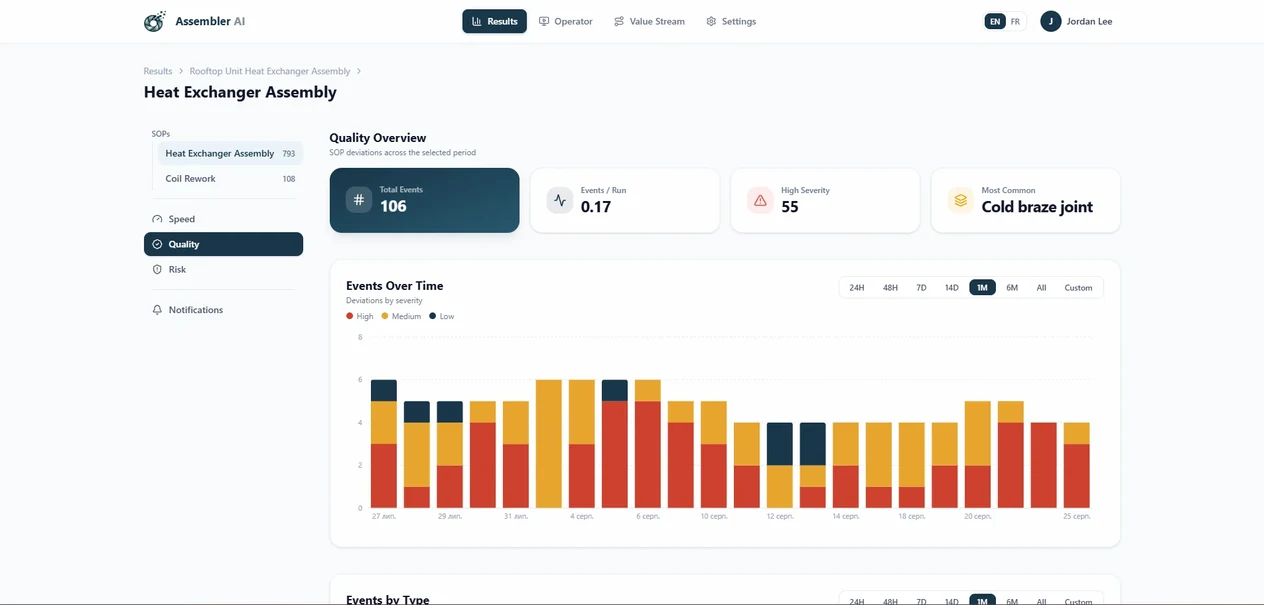
Real-Time Quality Alerts
Sequence, part identity, and correct placement on every cycle. Left against right, correct box, correct tray, minimum inspection dwell time, no skipped gauge check. Count verification against a target per pallet catches the short pallet before it ships.
Explore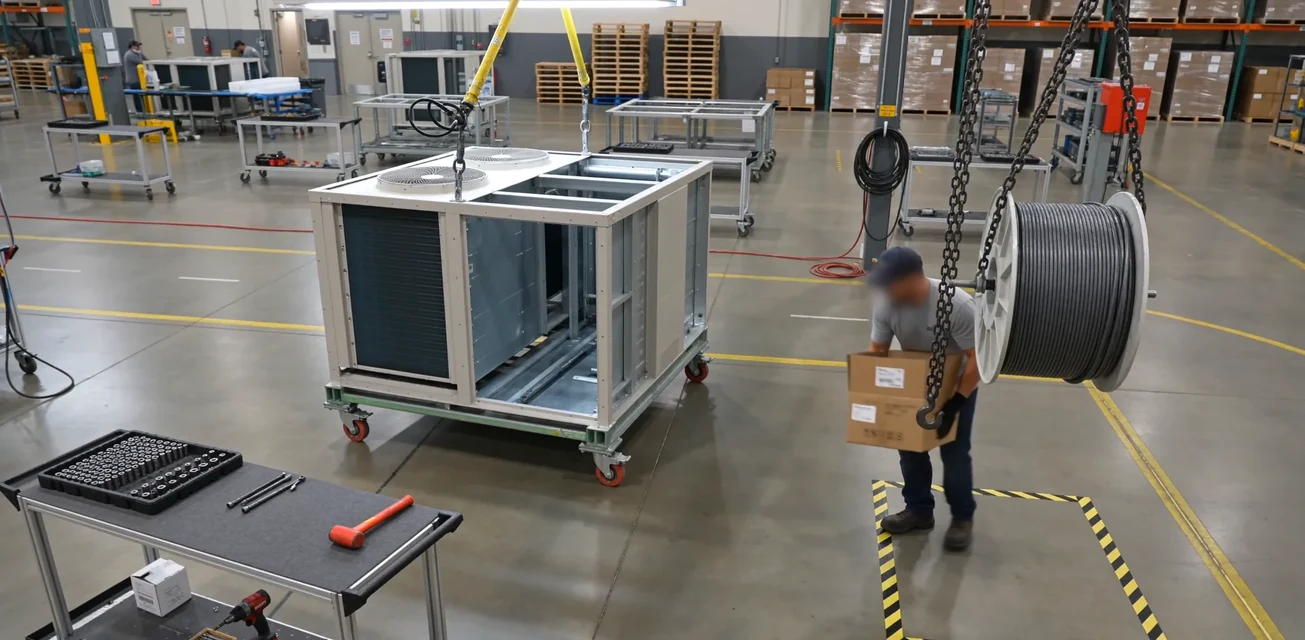
Real-Time Risk Detection
The list your work instructions never cover. Zone rules that keep finished surfaces from getting scratched, a part set aside and picked back up minutes later, work accumulating faster than it clears.
Explore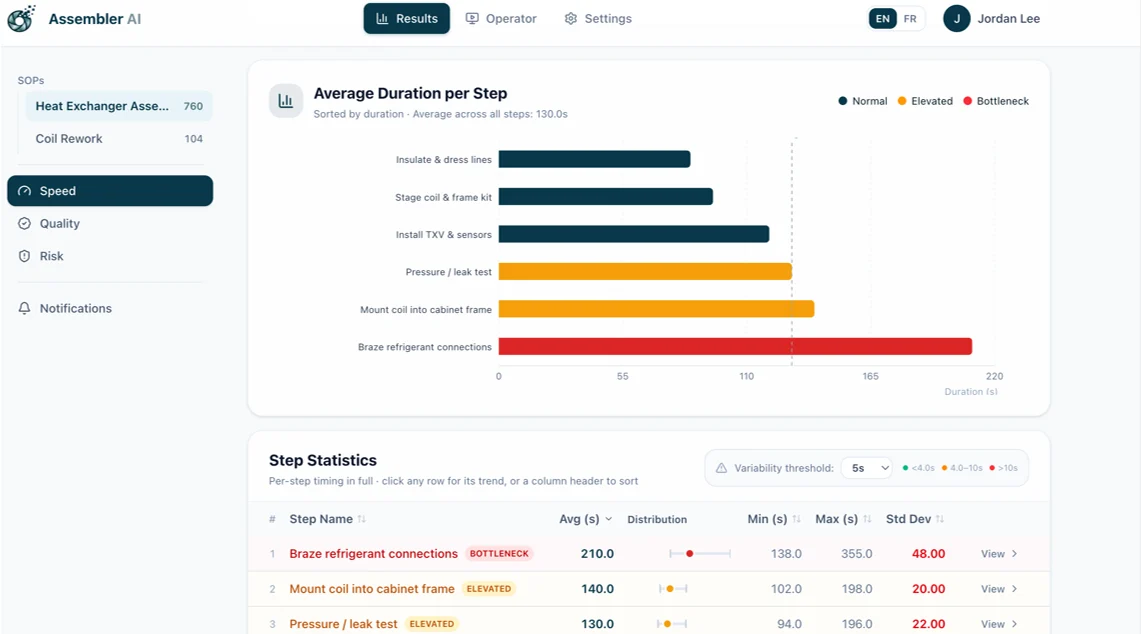
Continuous Improvement Insights
Step-level cycle times across every station and shift, with video on every outlier. It answers the questions nobody can answer today. Why did that cycle take twice as long. Why does the night shift run three times slower than days. Why does the same station in your Mexico plant take fifty percent longer than the one in your US plant.
Explore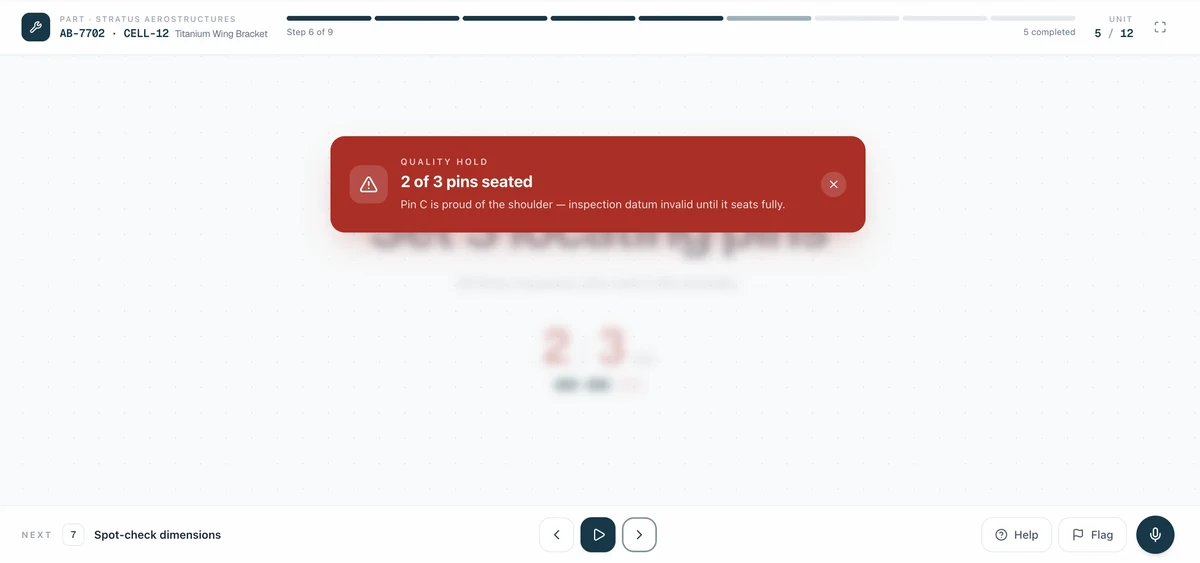
Real-Time Operator Guidance
Live step guidance at the bench. The operator sees the next step, and a wrong one gets flagged while the piece is still at the station.
ExploreWho this is for, and what they get
Quality
The escape that never reaches your customer, and the video that proves what happened when one does. Root cause on a manual build stops being a room full of people reconstructing a unit from memory. Sequence, part identity, and inspection dwell time get checked on every cycle rather than on the ones somebody sampled.
Continuous improvement
A time study that runs itself on every station, instead of the quarterly pass you make with a stopwatch and a clipboard. Setup variance from run to run, drift by shift, and the video behind every outlier. It also tells you which changes actually worked, which is the part your quarterly studies never covered.
Operations leadership
Every station and every shift on one screen, with the ability to compare cells, shifts, and plants against each other. Scrap and rework carry a shop rate, and the data ties both back to the step that produced them. That’s the cost-down argument your customer’s purchasing team can’t wave off.
Operators and production managers
New operators reach the rate of your experienced ones faster, because the correction arrives at the bench while it still costs seconds. Faces are blurred, no names or IDs are collected, and the footage protects the operator who did the job right as often as it flags the one who didn’t.
Where this runs in an automotive plant
01Injection molding cells
Sprue cut, inspect both sides, bag, label, correct box, every cycle
See injection molding02Kitting and packaging
Front and rear, left and right, the right count in the right carton
See assembly03Subassembly and bracket stations
Sequence, fasteners, missing components
See assembly04Inspection benches
Dwell time, both sides of the part, scrap and pass counts without a clipboard
See inspection05CNC and machining cells
Setup, tool change, orientation, measurement, deburr, final check
See CNC
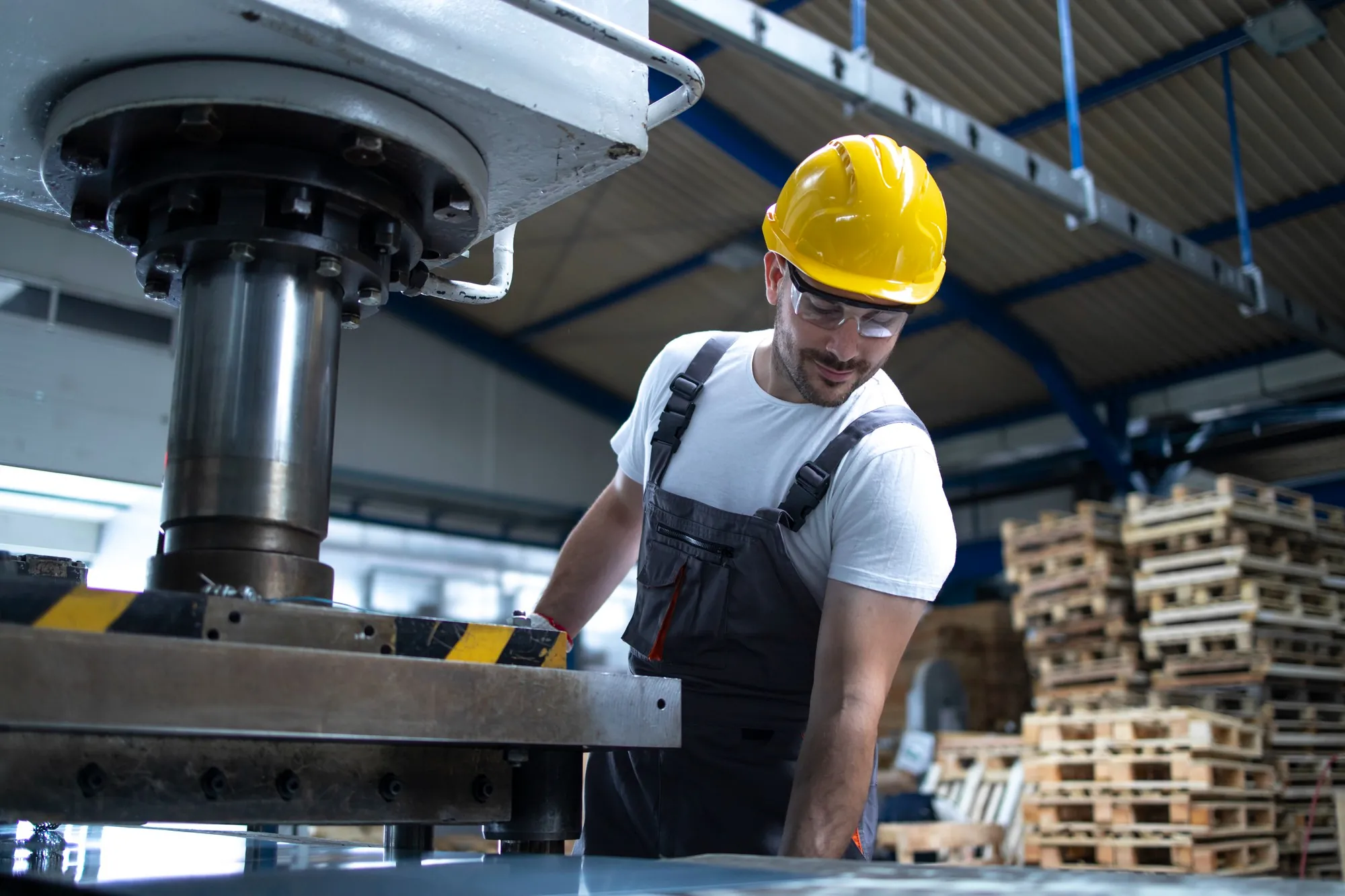
Operator Vision runs in unionized automotive plants. Faces are blurred, no operator names or IDs are collected, and nothing tracks an individual operator.
- Faces blurred at the edge, before footage leaves the plant
- No operator names or IDs collected
- Role-based permissions your team sets, site by site
Access works on the same principle. Only the people who need to see footage can see it, with role-based permissions your team sets, so a supervisor at one site isn’t looking at another site’s floor.
Agreements vary, and Assembler AI works through the conversation with your union representatives alongside you. The deployments that go smoothly start the same way, with everyone in the room before the camera goes up.
Two weeks, and the line doesn’t stop
Send your work instructions on day one. The camera goes up in week one, off-the-shelf NDAA-compliant hardware Assembler AI supplies and provisions, on its own subnet, streaming out over an encrypted VPN. Nothing about the station changes and the line keeps running while the camera goes up. Week two is calibration. Anything the camera sees that your paperwork doesn’t account for gets settled with your team before a rule goes live on day fifteen. That’s two weeks on a station with one operator, closer to three where several people share a bench. Stations after the first go up in parallel, so covering a line or a plant is measured in weeks rather than one station at a time.
See what deployment looks likeStart with one station. The data gets more valuable with every one you add
Nobody wires up a plant on a vendor’s promise. So you start small, with one station, on the bench producing the most escapes or the most unexplained variance. Two weeks later you have step-level data on your own parts. Small commitment, real answer.
What happens after is the part worth understanding before you begin. This data is comparative, so every station you add makes the ones you already have more useful.
One station
How the work actually happens against how it’s written. Step times, the deviations nobody logged, and the steps in your work instructions that no operator has run in years.
The line
Compare benches running the same work. Setup variance between operators and shifts becomes a number with video behind it, which is the difference between a standard you argue about and one you can prove.
The factory
Shifts and cells become directly comparable. Why the night shift takes three times as long. Which cell absorbs a changeover fastest. When you change a process, you can measure whether it worked instead of asking around.
Across sites
The same part number built in two plants becomes comparable for the first time. Why the same station takes fifty percent longer in Mexico than in your US plant, with video from both. The best method in your group becomes the standard across it.
For a supplier running the same program in more than one plant, that last one is usually where the number gets big. It’s also the cost-down argument your customer’s purchasing team can’t dismiss, because it’s evidence from your own floor rather than a promise. If you’re heading toward multiple sites, tell Assembler AI early and we’ll scope single sign-on, role-based permissions, and per-site data separation with your IT and HR teams while the first station runs.
Questions your team will ask
In most cases no, and high-mix work is the environment Operator Vision was built for. Where your SKUs look visually different, Operator Vision identifies which part is in production and switches automatically as the line changes over, so you don’t tell it what’s running and you don’t reconfigure between builds.
Operator Vision adapts on its own to minor variations and to changes in step order. A significant change to the work itself, a new machine or a new tool, needs retraining, and so does a new SKU. Assembler AI takes care of that retraining for you. We won’t pretend Operator Vision recognizes completely different looking parts it has never seen.
Assembler AI’s proprietary manufacturing vision models start around 80 percent accuracy on a new station and reach the mid 90s after the initial calibration. Those first two weeks are what get it there on your parts rather than in a demo.
A camera watching every cycle sees the shortcut a quarterly audit never would, which is most of the answer. Some patterns we’ve heard about are operators scrapping good parts to speed up the line. If you’ve seen similar patterns on your floor, name them during calibration and Operator Vision will check for them.
No. Your work instructions are the only required input. Assembler AI provides MES and ERP integrations when you want part data flowing in and results flowing out.
It’s arguably the best time. Right after PPAP you’re on version one of the work instructions, your operators are still learning the process, and scrap in that first month typically runs five to ten times normal. That’s exactly when step-level data is worth most. Operator Vision needs a minimum of 100 to 200 cycles to learn a station, so tell us your build volumes and we’ll tell you when to start.
You do. Encrypted in transit and at rest, isolated per customer, default twelve-month retention you can change or export from at any time. Production data stays in a US or Canadian cloud region, and you choose which.
Pick the station that worries you most
Bring us the one that keeps producing escapes, or the one where nobody can say why setup takes an hour on Tuesday and two on Thursday. Operator Vision goes live in two weeks and you have numbers on your own parts inside the month.
No MES integration required and easily scales across your sites.