
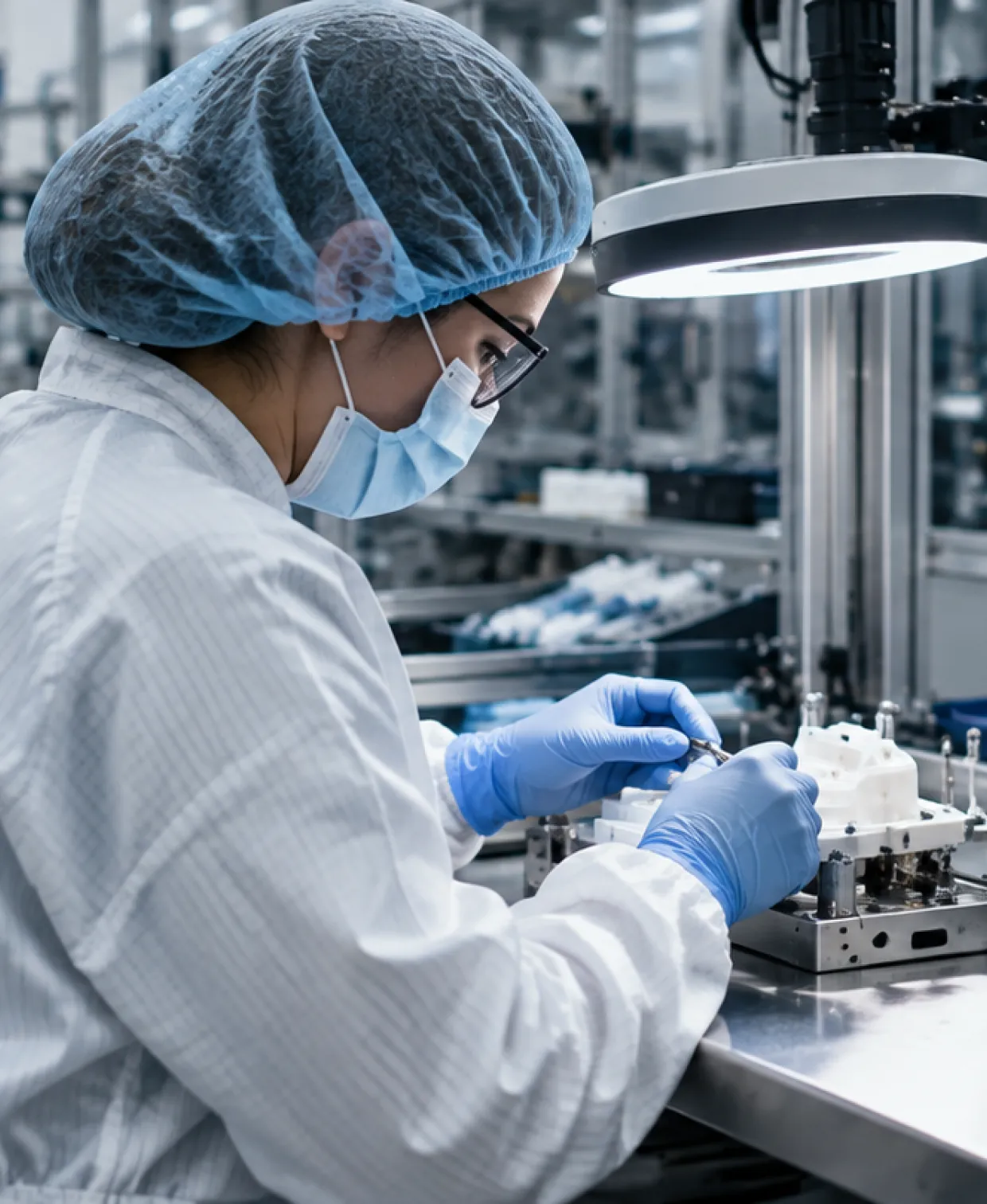
You build devices that can’t fail
A device that keeps someone alive has no acceptable failure rate, and most of yours are built by hand. Operator Vision checks every step in your work instructions on every cycle, along with the clean room rules your operators are trained on but no system tracks. When something goes wrong the operator is alerted at the station, and a supervisor gets the video in time to pull the affected unit and keep the rest of the batch clean.
Live in two weeks. No MES integration required. Your work instructions are the only input Operator Vision needs.
Clean room work adds a whole category of failure, and the cost pressure doesn’t move
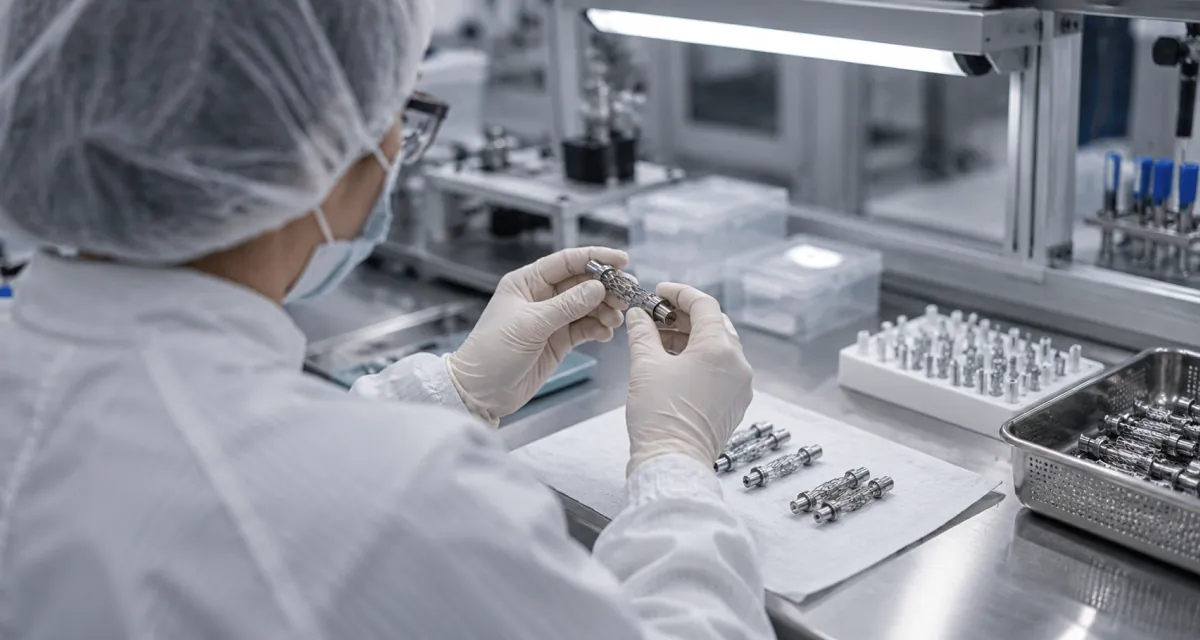
Every manufacturer worries about a missed step. You worry about that plus an entire second list: contamination, handling, glove discipline, and the rules that exist because of where the work happens rather than what the work is. You already have those rules. They’re documented, they’re in your operator training, and everyone on that floor could recite them. What you don’t have is anything tracking whether they’re followed, because they sit outside the work instructions that describe the build. A rule everybody knows and no one records is a rule you’re taking on trust. And the consequence isn’t one part. It’s a batch in question, a quality investigation, paperwork that costs more than the product, and in the worst case a recall and the customer trust that goes with it. Meanwhile the same station has to run at volume and at a competitive cost.
The two lists, and only one of them is in the work instructions
A step missed or run out of order
The same failure every manual line has, with a regulated record attached to it and a batch-level consequence when it isn’t caught.
A part off the floor and back on the line
The signature clean room event. Two seconds, no witness, and the batch is now suspect.
Handling that breaks the gowning rules
Bare-hand contact on a surface that calls for gloves, or a component set down somewhere that hasn’t been cleared for it.
Movement through a space that has to stay clear
An operator in a zone the procedure routes around, at the moment it matters.
Inspection that gets short-changed
When parts stack up, the check that should take three seconds takes one, and the record shows it was performed either way.
Multiple operators on one bench
Several people working the same station at once, each running their own tasks, and no way to say afterwards which action belonged to which cycle
What the work is costing before anyone measures it
- 50–70%
- of scrap at high-mix, low-volume manufacturers traces back to how the work was performed, rather than to suppliers or design
- 15–30%
- of throughput lost when operators drift from the standard
- Half
- the time your continuous improvement engineers spend on manual time studies, given back. That’s the target Assembler AI builds to.
One camera feed. All four modules
You don’t buy these separately. One camera feed above the station runs all four at once, with no MES integration required.
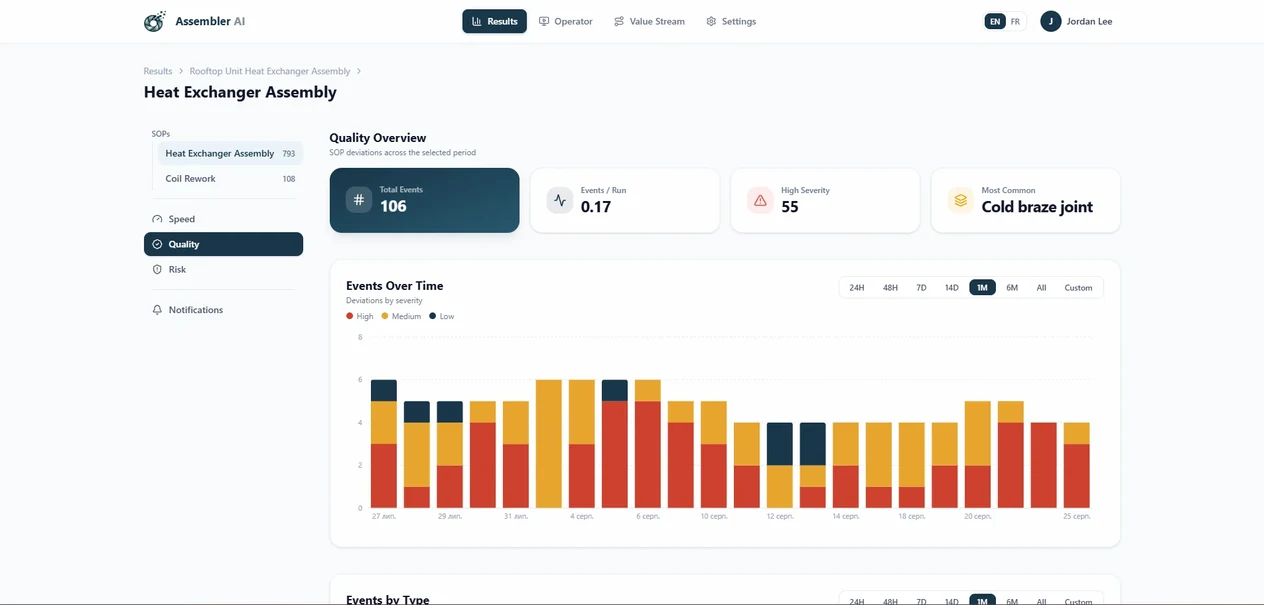
Real-Time Quality Alerts
Every step in the work instructions confirmed or flagged, in sequence, on every cycle, with timestamped video behind each one. Minimum inspection dwell time is enforced, so a check that couldn’t have happened doesn’t get recorded as one.
Explore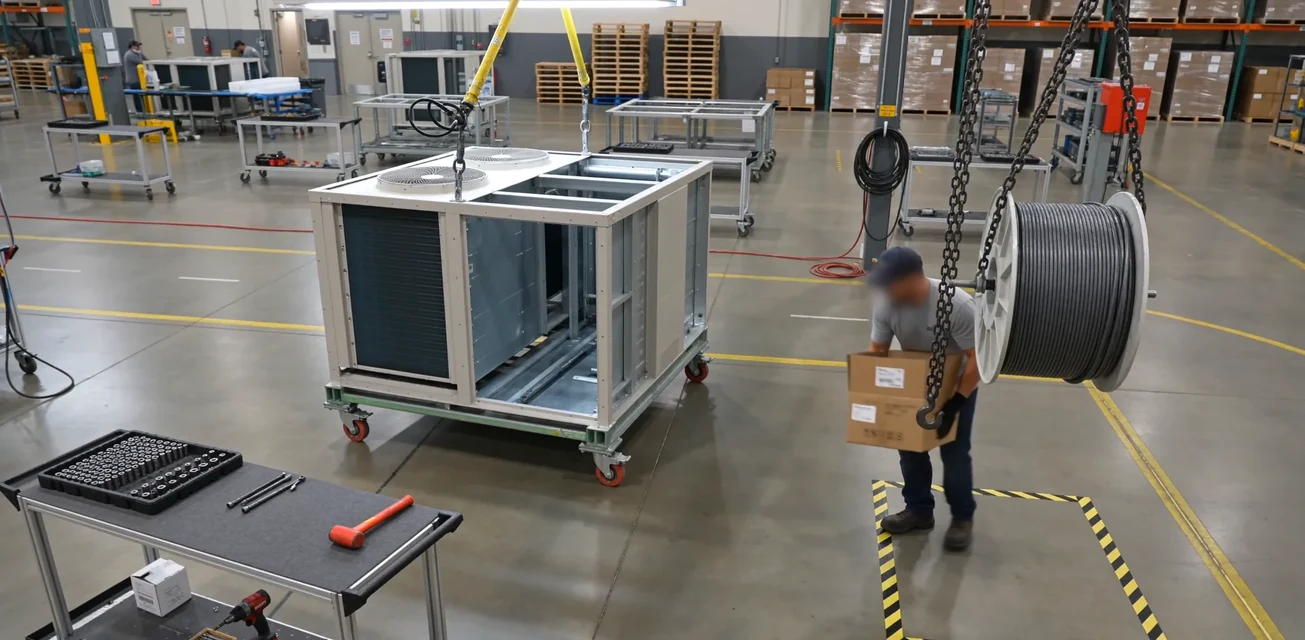
Real-Time Risk Detection
The second list, the one no one wrote down. A part off the floor, bare-hand contact where the procedure calls for gloves, a component staged somewhere it hasn’t been cleared for, an operator in a space that has to stay clear. Contamination events escalate immediately, with video, while there’s still time to pull the unit.
Explore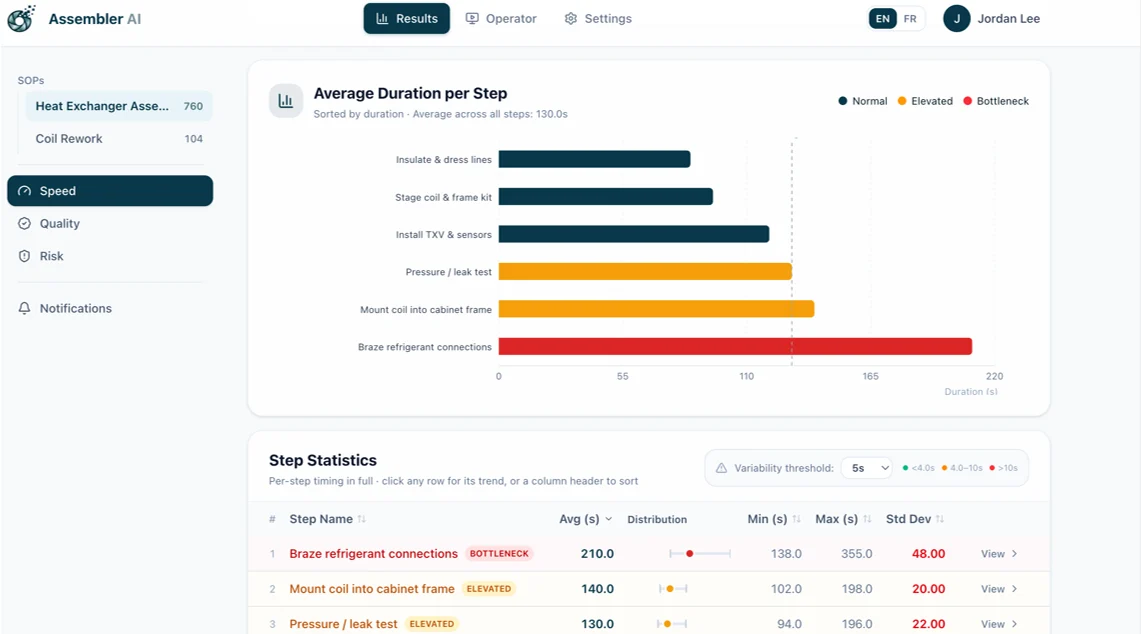
Continuous Improvement Insights
Step-level times across every station and shift, with video on every outlier. Gowning and clean room protocol add time that no one has ever measured properly, and this is where you see it.
Explore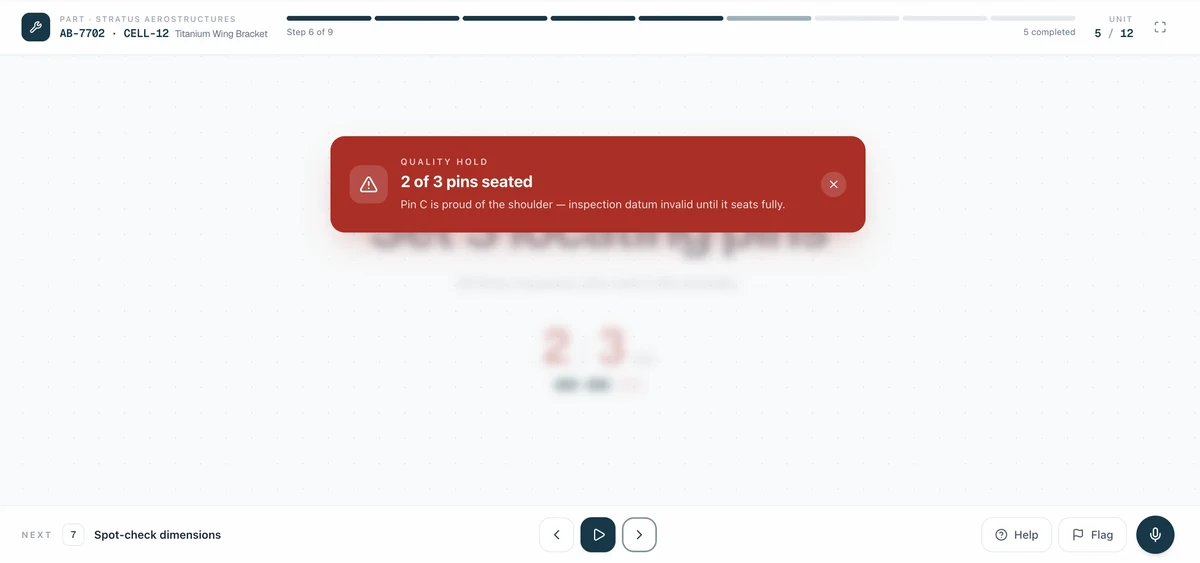
Real-Time Operator Guidance
The work instructions on a screen at the station, following along, with the current step in front of the operator and an alert that holds until the action matches.
ExploreWho this is for, and what they get
Quality
Every step verified on every unit rather than on the ones somebody sampled, and clean room rules verified alongside them. When an investigation opens, the video of the actual cycle is one click from the alert, so a deviation report gets written from footage rather than from recollection.
Continuous improvement
A time study that runs itself, instead of days spent reviewing video by hand to build one. Step-level variance by station, shift, and SKU, with the video on every outlier, and improvement tracking that shows what each change actually did to cycle time
Operations leadership
Every station and every shift on one screen, with contamination and handling events visible as a trend rather than as isolated incidents. Scrap and rework carry a cost, and the data ties both back to the step that produced them
Operators and production managers
New operators reach the rate of your experienced ones sooner, because the correction arrives at the station while it still costs seconds. Faces are blurred, no names or IDs are collected, and the footage protects the operator who did the job right as often as it flags the one who didn’t
Where this runs in a medical device plant
01Assembly and clean room benches
Sequence, components, handling, and the rules that were never written as steps
See assembly02Inspection benches
Dwell time, both sides of the part, scrap and pass counts without a clipboard
See inspection03Injection molding cells
Sprue cut, inspect, bag, label, correct box, every cycle
See injection molding04Kitting and packaging
The right components in the right kit, the right count, the right label
See assembly
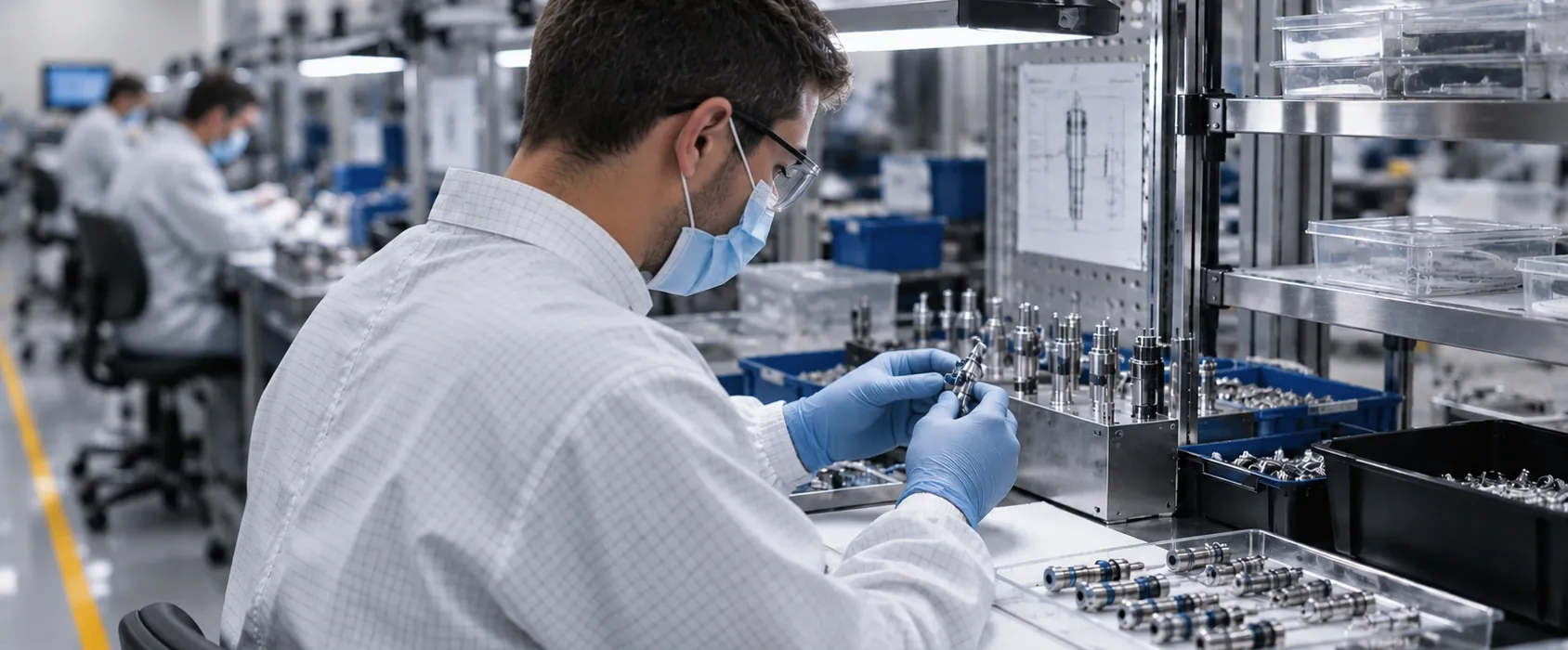
Your quality system already requires that deviations get documented. What it can’t give you is a record of what actually happened at the station, because the paperwork is filled in by the person who was building rather than by someone watching.
Operator Vision holds timestamped video for every flagged cycle, indexed by step. A deviation report gets written from the footage. An investigation into a batch becomes a lookup rather than an afternoon of reconstruction. When a customer or an auditor asks whether the procedure was followed on the units they received, the answer stops being an assertion.
The record is anonymized by design. Faces are blurred by default, Operator Vision doesn’t collect operator names or IDs, and events come back tied to a station and a shift. What you get is evidence about the process, which is what a deviation investigation is supposed to be about.
Two weeks, and the line doesn’t stop
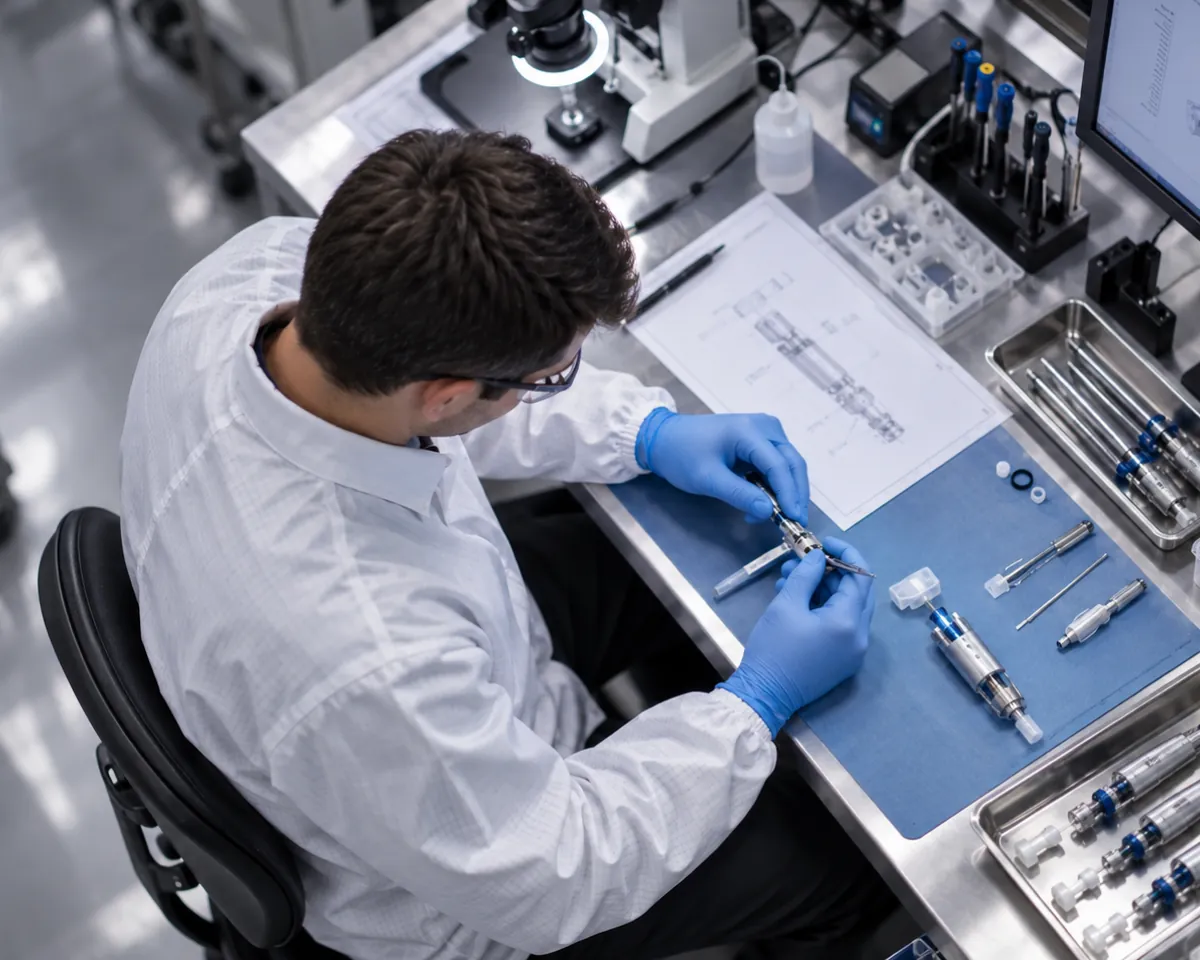
Send the work instructions you already have on day one, and if a station has none written down, Assembler AI will work with you to create them. The camera goes up in week one, NDAA-compliant hardware Assembler AI supplies and provisions, on its own subnet, streaming out over an encrypted VPN. Nothing about the station changes and nothing enters the clean room except the camera and its mount. Week two is calibration and training the model on your alerts, including the second list. Most teams name a few clean room rules right away and add more once they’ve watched two weeks of footage. That’s two weeks on a station with one operator, closer to three where several people share a bench. Stations after the first go up in parallel.
See what deployment looks likeStart with one station. The data gets more valuable with every one you add
No one instruments a plant on a vendor’s promise. So you start small, with the station where a contamination event would cost you most. Two weeks later you know how often the rules are actually being broken, on your own floor, with video.
What happens after is worth understanding before you begin. This data is comparative, so every station you add makes the ones you already have more useful.
One station
How often the events on your list actually occur, and what’s causing them
The build line
The same rule across several benches shows you whether it’s one station’s problem or a pattern. A part coming off the floor at every station is a layout problem, not a training problem.
The factory
Shifts and cells compare against each other. A habit spreading on second shift is visible while it’s still a habit rather than a deviation report
Across sites
The same build in two plants becomes comparable for the first time. A practice one plant has solved becomes the standard everywhere, with video of what solved it.
If you’re heading toward multiple sites, tell Assembler AI early and we’ll scope single sign-on, role-based permissions, and per-site data separation with your IT and HR teams while the first station runs.
Questions your team will ask
Yes, and it’s where this proves itself quickly. Floor contact and zone rules are what clean room customers ask for first. Full clean room clothing does change what a camera can tell apart, so the specific rules get confirmed against your station during calibration rather than promised ahead of it.
No. Stations with several operators running tasks simultaneously are among the ones Operator Vision already runs on. Allow closer to three weeks for calibration instead of two, because there’s more variation to learn.
You tell us. Most medical manufacturers already have these documented and in operator training, so the list exists and the work is turning it into checks Operator Vision runs on every cycle. Where a station has gaps, Assembler AI helps you fill them during calibration.
Operator Vision sits alongside your process rather than in it. It doesn’t touch the product, the equipment, or the record your quality system relies on. It adds an independent video record of what happened. Bring your quality team into the first conversation so the scope is agreed before anything goes up.
No. Faces are blurred and no names or IDs are collected. Events come back tied to a station and a shift, which is the version that supports a process investigation.
No. Your work instructions are the only required input. Assembler AI provides MES and ERP integrations when you want data flowing both ways.
Assembler AI’s proprietary manufacturing vision models start around 80 percent accuracy on a new station and reach the mid 90s after the initial calibration. Those first two weeks are what get it there on your parts rather than in a demo.
You do. Encrypted in transit and at rest, isolated per customer, default twelve-month retention you can change or export from at any time. Production data stays in a US or Canadian cloud region, and you choose which.
Tell us what would put a batch in question
Bring us the one action at that station that would make you stop and investigate. Operator Vision goes live in two weeks and you’ll know how often it’s happening.
No MES integration required, and it scales easily across your sites.